Passer au contenu

/ Département de mathématiques et de statistique

Je donne

Rechercher


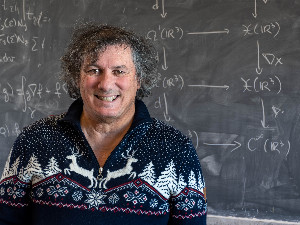
Perron, François

Vcard

Honorary professor

Faculty of Arts and Science - Department of Mathematics and Statistics

André-Aisenstadt Office 6188

514 343-6130

Courriels

Affiliations

  • Membre Centre de recherches mathématiques
  • Membre CRM — Centre de recherches mathématiques

Research area

Student supervision Expand all Collapse all

Correction d'estimateurs de la fonction de Pickands et estimateur bayésien Theses and supervised dissertations / 2023-01
Chalifoux, Kevin
Abstract
Estimating a bivariate extreme-value copula is equivalent to estimating A, its associated Pickands function. This function A: [0,1] \( \rightarrow \) [0,1] must satisfy some constraints : $$\max\{1-t, t \} \leq A(t) \leq 1, \hspace{3mm} t\in[0,1]$$ $$\text{A is convex.}$$ Many estimators have been proposed to estimate A, but few satisfy the imposed constraints. The main contribution of this thesis is the introduction of a simple correction technique for Pickands function estimators so that the corrected estimators respect the required constraints. The proposed correction uses a new property of the extreme-value random vector and the convex hull of the obtained estimator to guaranty the respect of the Pickands function constraints. The second contribution of this thesis is to present a nonparametric bayesian estimator of the Pickands function based on the form introduced by Capéraà, Fougères and Genest (1997). The estimator uses Dirichlet processes to estimate the cumulative distribution function of a transformation of the extreme-value bivariate vector. Analysis by simulations and a comparison with popular estimators provide a measure of performance for the proposed correction and bayesian estimator. The analysis is done on 18 bivariate extreme-value distributions. The correction reduces the mean square error on all distributions. The bayesian estimator has the lowest mean square error of all the considered estimators.

Estimation bayésienne d'une fonction de Pickands par des splines cubiques Theses and supervised dissertations / 2021-07
Gueye, Mohamed
Abstract
The subject of our thesis is intersection between two fields: The Extreme Value Theory (EVT) and copulas. The object of EVT is to find the limit law of the maximum of a sample. Due to the results of EVT, we can model extreme phenomena. In addition, there is a bivariate variant of EVT. The bivariate variant of EVT uses a family of copulas called extreme value copulas to account for the connection between the two extreme events. Any copula with extreme values depends on a Pickands function. The object of our thesis is to estimate the Pickands function from data. We have found a way to build a Pickands function using cubic splines. From this construction, we obtain an extended family of Pickands functions in which we perform our statistical inference. We chose the Bayesian approach to build the estimator and the MCMC methods for the estimates. The method was applied on simulated and real data.

Étude d’algorithmes de simulation par chaînes de Markov non réversibles Theses and supervised dissertations / 2020-10
Huguet, Guillaume
Abstract
Markov chain Monte Carlo (MCMC) methods commonly use chains that respect the detailed balance condition. These chains are called reversible. Most of the theory developed for MCMC evolves around those particular chains. Peskun (1973) and Tierney (1998) provided useful theorems on the ordering of the asymptotic variances for two estimators produced by two different reversible chains. In this thesis, we are interested in non-reversible chains, which are chains that don’t respect the detailed balance condition. We present algorithms that simulate non-reversible chains, mainly the Guided Random Walk (GRW) by Gustafson (1998) and the Discrete Bouncy Particle Sampler (DBPS) by Sherlock and Thiery (2017). For both algorithms, we compare the asymptotic variance of estimators with the ones produced by the Metropolis- Hastings algorithm. We present a recent theoretical framework introduced by Andrieu and Livingstone (2019) and their analysis of the GRW. We then show that the DBPS is part of this framework and present an analysis on the asymptotic variance of estimators. Their main theorem can provide an ordering of the asymptotic variances of two estimators resulting from nonreversible chains. We show that an estimator could have a lower asymptotic variance by adding propositions to the DBPS. We then present empirical results of a modified DBPS. Through the thesis we will mostly be interested in chains that are produced by deterministic proposals. We show a general construction of the delayed rejection algorithm using deterministic proposals and one possible equivalent for non-reversible chains.

Estimation de paramètres en exploitant les aspects calculatoires et numériques Theses and supervised dissertations / 2017-08
Kadje Kenmogne, Romain
Abstract
In this thesis, we are mainly interested in the estimation of parameters. It consists of three papers in which we discuss estimation problems in specific models. In the first paper, we consider the Farlie-Gumbel-Morgenstern parametric family of copulas. The observations come from a distribution that involves both the copula and the margins, through the decomposition of the Sklar's theorem. Margins are unknown. In the estimation of a function of the parameter of the copula, pseudo-likelihood is often used instead of the likelihood. It is an approach that will generally produce non-efficient estimators, especially for small sample sizes. In pseudo-likelihood, margins are replaced by estimators that depend on the ranks. We propose to use the rank-likelihood, which is the likelihood based on the distribution of the rank statistics. This approach can be complex in practice because we work on the permutation group and we calculate multiple integrals. However, it is possible to do the calculations for the Farlie-Gumbel-Morgenstern family of copulas. We compare the estimators obtained from these approaches using the Bayesian method. The results of numerical studies are presented. Some estimators found in the literature are ratios of normal random variables. In the second paper, we are interested in the distribution of the ratio of two normal random variables. Several authors have addressed this subject. The new parametrization that we introduced allows us to obtain new results faster and effortlessly. Firstly, we show that the expression of the density of the ratio can be written as a mixture of densities belonging to a new family that we create. We find some properties, and we give the analytic expression of the characteristic function for the new family. This new family is in fact a generalization of the family of densities of Student distributions having odd degrees of freedom. We obtain convergence results generalizing the one for Student distributions when the degree of freedom tends to infinity. Similar results of convergence as well as some properties are developed for the distribution of the ratio. We use a Bayesian approach to estimate the ratio of the means of two normal random variables. Graphical illustrations and simulation results are presented. In the third paper, we extend the family of distributions, resulting from the difference of two independent random variables having a gamma distribution, by considering the case where these random variables are positively correlated. The densities in this family are found. Their complex forms make tedious the estimation methods based on the likelihood. The estimation method based on the characteristic function is used, and the continuous approach is compared to the discrete approach. Moreover, we developed two simple algorithms for generating data from two positively correlated and identically distributed random variables having a gamma distribution. The best equivariant estimator for the scale parameter is obtained in the case of independence.

Sur les prolongements de sous-copules Theses and supervised dissertations / 2015-02
Ajavon, Ayi
Abstract
The extension of subcopulas is an important domain. One of possible applications is the nonparametric estimation of a copula: it consists of the smoothing of a subcopula (the empirical copula) while preserving the copulas properties. In Chapter 2, we present an extension of the empirical copula based on the tensor product of splines functions. Our estimators are bona fide estimators of the copula. Chapter 3 tackles the problem of finding all possible extensions of a given subcopula. This subject has been treated in the literature but these characterizations do not apply on very general spaces. Chapter 4 deals with the following problem: finding the expression of the upper bound of the extensions of a finite subcopula in dimension 3.

Estimation utilisant les polynômes de Bernstein Theses and supervised dissertations / 2013-03
Tchouake Tchuiguep, Hervé
Abstract
This thesis focuses on the presentation of the Bernstein estimators which are recent alternatives to conventional estimators of the distribution function and density. More precisely, we study their various properties and compare them with the empirical distribution function and the kernel method estimators. We determine an asymptotic expression of the first two moments of the Bernstein estimator for the distribution function. As the conventional estimators, we show that this estimator satisfies the Chung-Smirnov property under conditions. We then show that the Bernstein estimator is better than the empirical distribution function in terms of mean squared error. We are interested in the asymptotic behavior of Bernstein estimators, for a suitable choice of the degree of the polynomial, we show that the Bernstein estimators are asymptotically normal. Numerical studies on some classical distributions confirm that the Bernstein estimators may be preferable to conventional estimators.

Estimation bayésienne nonparamétrique de copules Theses and supervised dissertations / 2008
Guillotte, Simon
Abstract
Thèse numérisée par la Division de la gestion de documents et des archives de l'Université de Montréal.

Méthode de simulation avec les variables antithétiques Theses and supervised dissertations / 2007-06
Gatarayiha, Jean Philippe
Abstract
In this master thesis, we consider simulation methods based on antithetic variates for estimate integrales of f(x) on interval (0,1] where f is monotonic function, not a monotonic function or a function difficult to integrate. The main idea consists in subdividing the (0,1] in m sections of which each one is subdivided in l subintervals. This method is done recursively. At each step the variance decreases, i.e. The variance obtained at the kth step is smaller than that is found at the (k-1)th step. This allows us to reduce the error in the estimation because the estimator of integrales of f(x) on interval [0,1] is unbiased. The objective is to optimize m.

Estimation non-paramétrique de la fonction de répartition et de la densité Theses and supervised dissertations / 2007
Haddou, Mohammed
Abstract
Thèse numérisée par la Direction des bibliothèques de l'Université de Montréal.

Problèmes d'estimation de paramètres avec restriction sur l'espace des paramètres Theses and supervised dissertations / 2003
Gueye, N'deye Rokhaya
Abstract
Thèse numérisée par la Direction des bibliothèques de l'Université de Montréal.

Quelques contributions sur les méthodes de Monte Carlo Theses and supervised dissertations / 2003
Atchadé, Yves F.
Abstract
Thèse numérisée par la Direction des bibliothèques de l'Université de Montréal.

Estimation équivariante de paramètres multivariés avec contraintes Theses and supervised dissertations / 2000
Gueye, N'deye Rokhaya
Abstract
Mémoire numérisé par la Direction des bibliothèques de l'Université de Montréal.

Bornes exponentielles pour les probabilités de grandes déviations de sommes de variables aléatoires indépendantes et markoviennes Theses and supervised dissertations / 1997
León, Carlos Antonio
Abstract
Thèse numérisée par la Direction des bibliothèques de l'Université de Montréal.

Application de l'invariance en théorie de la décision Theses and supervised dissertations / 1987
Perron, François
Abstract

Research projects Expand all Collapse all

Centre de recherches mathématiques (CRM) FRQNT/Fonds de recherche du Québec - Nature et technologies (FQRNT) / 2022 - 2029

Statistique bayésienne, théorie de la décision et méthodes de simulation par chaînes de Markov CRSNG/Conseil de recherches en sciences naturelles et génie du Canada (CRSNG) / 2018 - 2025

Statistique bayésienne, théorie de la décision et méthodes de simulation par chaînes de Markov CRSNG/Conseil de recherches en sciences naturelles et génie du Canada (CRSNG) / 2018 - 2024

CENTRE DE RECHERCHES MATHEMATIQUES (CRM) FRQNT/Fonds de recherche du Québec - Nature et technologies (FQRNT) / 2015 - 2023

BAYESIAN ESTIMATION OF A COPULA, MCMC AND DECISION THEORY CRSNG/Conseil de recherches en sciences naturelles et génie du Canada (CRSNG) / 2013 - 2019

COMPUTATIONAL RESOURCES FOR RESEARCH IN MATHEMATICS AND STATISTICS CRSNG/Conseil de recherches en sciences naturelles et génie du Canada (CRSNG) / 2013 - 2015

CENTRE DE RECHERCHES MATHEMATIQUES (CRM) FRQNT/Fonds de recherche du Québec - Nature et technologies (FQRNT) / 2008 - 2016

BAYESIAN NONPARAMETRIC ESTIMATION, MCMC AND DECISION THEORY / 2008 - 2012

Selected publications Expand all Collapse all

On runs, bivariate Poisson mixtures and distributions that arise in Bernoulli arrays

Ait Aoudia, Djilali, Marchand, Éric, Perron, François et Ben Hadj Slimene, Latifa, On runs, bivariate Poisson mixtures and distributions that arise in Bernoulli arrays 19, no. 8, 12 (2014), , Electron. Commun. Probab.

Unbiased and almost unbiased ratio estimators of the population mean in ranked set sampling

Jafari Jozani, Mohammad, Majidi, Saeed et Perron, François, Unbiased and almost unbiased ratio estimators of the population mean in ranked set sampling 53, 719--737 (2012), , Statist. Papers

Bayesian estimation of a bivariate copula using the Jeffreys prior

Guillotte, Simon et Perron, François, Bayesian estimation of a bivariate copula using the Jeffreys prior 18, 496--519 (2012), , Bernoulli

Non-parametric Bayesian inference on bivariate extremes

Guillotte, S., Perron, F. et Segers, J., Non-parametric Bayesian inference on bivariate extremes Vol. 73 no. 3, 377-406 (2011), , J. R. Stat. Soc. Ser. B Stat. Methodol

On the use of antithetic variables to improve over the ranked set sampling estimator of the population mean

Jozani, Mohammad Jafari et Perron, François, On the use of antithetic variables to improve over the ranked set sampling estimator of the population mean 73, 142--161 (2011), , Sankhya A

Estimating a bounded parameter for symmetric distributions

Marchand, Éric et Perron, François, Estimating a bounded parameter for symmetric distributions 61, 215--234 (2009), , Ann. Inst. Statist. Math.

A Bayesian estimator for the dependence function of a bivariate extreme-value distribution

Guillotte, Simon et Perron, François, A Bayesian estimator for the dependence function of a bivariate extreme-value distribution 36, 383--396 (2008), , Canad. J. Statist.

Metropolis-Hastings algorithms with adaptive proposals

Cai, Bo, Meyer, Renate et Perron, François, Metropolis-Hastings algorithms with adaptive proposals 18, 421--433 (2008), , Stat. Comput.

Adaptive rejection Metropolis sampling using Lagrange interpolation polynomials of degree 2

Meyer, Renate, Cai, Bo et Perron, François, Adaptive rejection Metropolis sampling using Lagrange interpolation polynomials of degree 2 52, 3408--3423 (2008), , Comput. Statist. Data Anal.

On the estimation of a restricted location parameter for symmetric distributions

Marchand, Éric, Ouassou, Idir, Payandeh, Amir T. et Perron, François, On the estimation of a restricted location parameter for symmetric distributions 38, 293--309 (2008), , J. Japan Statist. Soc.

On the geometric ergodicity of Metropolis-Hastings algorithms

Atchadé, Yves F. et Perron, François, On the geometric ergodicity of Metropolis-Hastings algorithms 41, 77--84 (2007), , Statistics

Minimax estimation of a constrained binomial proportion $p$ when $\vert p-1/2\vert$ is small

Marchand, Éric, Perron, François et Gueye, Rokhaya, Minimax estimation of a constrained binomial proportion $p$ when $\vert p-1/2\vert$ is small 67, 526--537 (2005), , Sankhyà

Improving on the mle of a bounded location parameter for spherical distributions

Marchand, Eric et Perron, François, Improving on the mle of a bounded location parameter for spherical distributions 92, 227--238 (2005), , J. Multivariate Anal.

Improving on the independent Metropolis-Hastings algorithm

Atchadé, Yves F. et Perron, François, Improving on the independent Metropolis-Hastings algorithm 15, 3--18 (2005), , Statist. Sinica

Optimal Hoeffding bounds for discrete reversible Markov chains

León, C. A. & Perron, F., Optimal Hoeffding bounds for discrete reversible Markov chains Vol. 14, no. 2, 958-970 (2004), , Ann. Appl. Probab.

On sums of products of Bernoulli variables and random permutations

Joffe, Anatole, Marchand, Éric, Perron, François et Popadiuk, Paul, On sums of products of Bernoulli variables and random permutations 17, 285--292 (2004), , J. Theoret. Probab.

Estimation of variance based on a ranked set sample

Perron, François et Sinha, Bimal K., Estimation of variance based on a ranked set sample 120, 21--28 (2004), , J. Statist. Plann. Inference

Extremal properties of sums of Bernoulli random variables

León, Carlos A. et Perron, François, Extremal properties of sums of Bernoulli random variables 62, 345--354 (2003), , Statist. Probab. Lett.

On the minimax estimator of a bounded normal mean

Marchand, Éric et Perron, François, On the minimax estimator of a bounded normal mean 58, 327--333 (2002), , Statist. Probab. Lett.

Improving on the MLE of a Bounded Normal Mean

Marchand, E. & Perron, F., Improving on the MLE of a Bounded Normal Mean Vol. 29, no. 4, 1078-1093 (2001), , Annals of Statistics

Bayesian nonparametric modeling using mixtures of triangular distributions.

Perron, F. & Mengersen, K., Bayesian nonparametric modeling using mixtures of triangular distributions. Vol. 57, no. 2, 518-528 (2001), , Biometrics

Beyond accept-reject sampling.

Perron, F., Beyond accept-reject sampling. Vol. 86, no. 4, 803-813 (1999), , Biometrika

Random selection in ranked set sampling and its applications

Li, Dayong, Sinha, Bimal K. et Perron, Francois, Random selection in ranked set sampling and its applications 76, 185--201 (1999), , J. Statist. Plann. Inference

On a conjecture of Krishnamoorthy and Gupta

Perron, François, On a conjecture of Krishnamoorthy and Gupta 62, 110--120 (1997), , J. Multivariate Anal.

Estimation of a mean vector in a two-sample problem

Perron, François, Estimation of a mean vector in a two-sample problem 46, 254--261 (1993), , J. Multivariate Anal.

Confidence sets having the shape of a half-space

Perron, F., Confidence sets having the shape of a half-space Vol 54, no. 3, 845-852 (1992), , J. Roy. Statist. Soc. Ser. B

Monotonic minimax estimators of a $2\times 2$ covariance matrix

Perron, François, Monotonic minimax estimators of a $2\times 2$ covariance matrix 20, 441--449 (1992), , Canad. J. Statist.

Minimax estimators of a covariance matrix

Perron, F., Minimax estimators of a covariance matrix 43, 16--28 (1992), , J. Multivariate Anal.

Best equivariant estimation in curved covariance models

Perron, F. et Giri, N., Best equivariant estimation in curved covariance models 40, 46--55 (1992), , J. Multivariate Anal.

Testing independence with additional information

Perron, François, Testing independence with additional information 19, 103--108 (1991), , Canad. J. Statist.

Equivariant estimators of the covariance matrix

Perron, François, Equivariant estimators of the covariance matrix 18, 179--182 (1990), , Canad. J. Statist.

On the best equivariant estimator of mean of a multivariate normal population

Perron, F. et Giri, N., On the best equivariant estimator of mean of a multivariate normal population 32, 1--16 (1990), , J. Multivariate Anal.

Equivariant estimation of a mean vector $\mu$ of $N(\mu,\Sigma)$ with $\mu'\Sigma^{-1}\mu=1$ or $\Sigma^{-1/2}\mu =c$ or $\Sigma=\sigma^2\mu'\mu I$

Kariya, Takeaki, Giri, N. C. et Perron, F., Equivariant estimation of a mean vector $\mu$ of $N(\mu,\Sigma)$ with $\mu'\Sigma^{-1}\mu=1$ or $\Sigma^{-1/2}\mu =c$ or $\Sigma=\sigma^2\mu'\mu I$ 27, 270--283 (1988), , J. Multivariate Anal.